

Solution
Vulnerability Prioritization Built for OT Reality
Go beyond scoring to identify the vulnerabilities that put your organization most at risk
Why Vulnerability Prioritization Fails in OT Environments
Effective prioritization requires operational context: how exposed a system is, how critical it is to operations. Traditional severity scoring can capture this reality, but adjusting scores to reflect operational reality is time-consuming. As a result, many fall back on the scores themselves to represent risk, leading to high-severity vulnerabilities with low operational risk taking priority over lower-severity vulnerabilities that pose a real threat.
Bastazo exists to close this gap by aligning vulnerability prioritization with the realities of OT operations in a sustainable and maintainable way for your team.

What Bastazo’s Vulnerability Prioritization Does
Bastazo evaluates vulnerabilities using a decision-driven approach that reflects operational reality.

Contextualizes vulnerabilities
Each vulnerability is evaluated in the context of asset exposure, operational criticality, and current exploit status rather than in isolation.
.svg)
Replaces static severity with decision logic
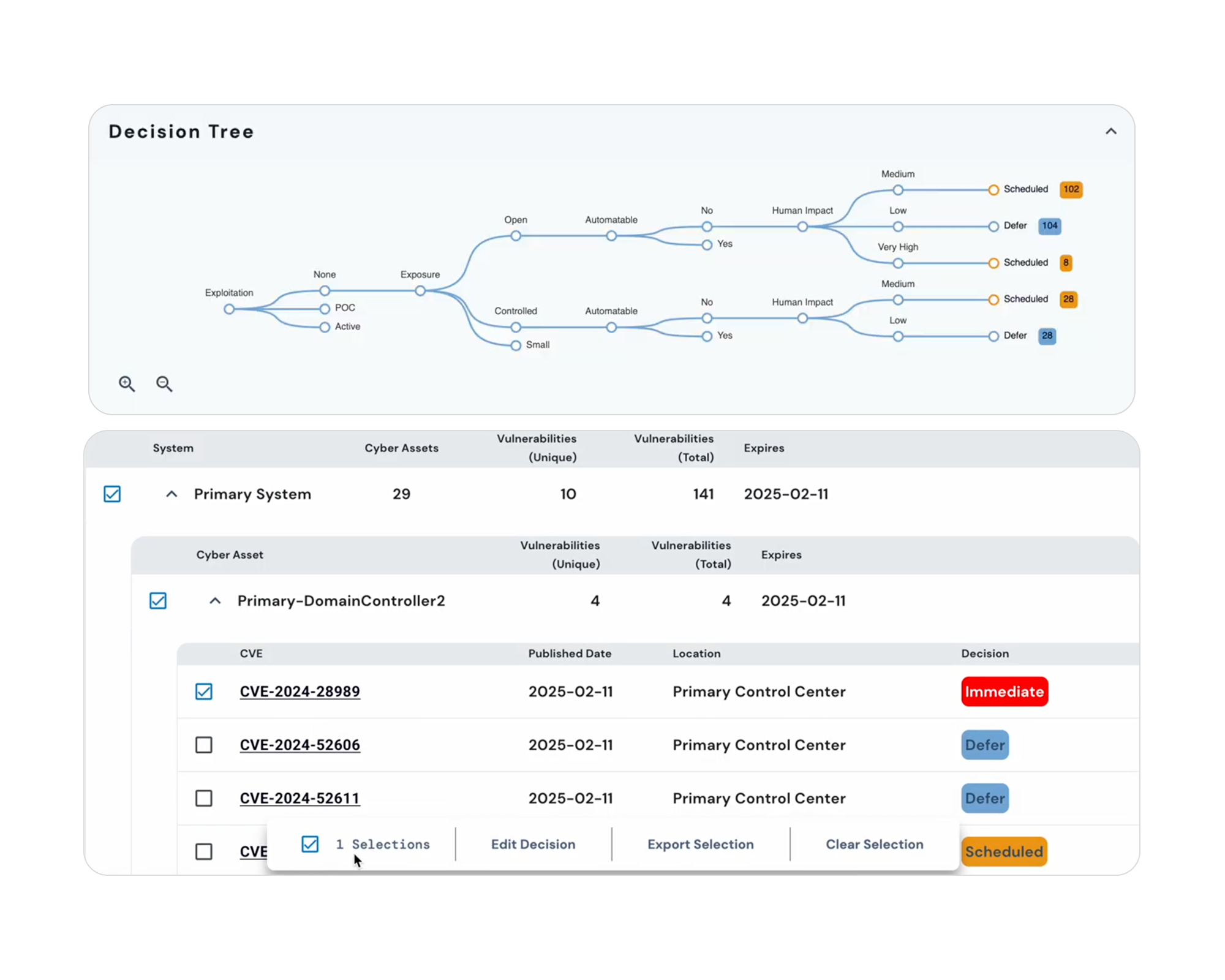
Instead of relying on CVSS or proprietary scoring, Bastazo applies SSVC decision trees to categorize a vulnerability into: Immediate, Out of Cycle, Scheduled, or Defer.

Produces clear, defensible outcomes
Every priority is transparent, repeatable, and explainable to operators, security teams, and auditors, helping to avoid further ambiguity in an already-complicated process. And it also promotes consistency across disparate teams.

How It Works

Ingest vulnerability data
Bastazo ingests vulnerability data from NVD, CISA KEV, and a range of other vulnerability enrichment feeds, then layers in our threat intel data based on your organization’s profile.

Evaluate real-world risk using SSVC
Each vulnerability is evaluated using SSVC decision criteria, including exploit maturity, system exposure, safety impact, and operational consequences.

Decide what action is required
Instead of producing a numeric risk score, Bastazo classifies vulnerabilities into clear, actionable categories that answer one operational question: What should we do next?

Focus on what truly matters
The result is a prioritized set of vulnerabilities (typically the most critical ~5%) that represent the greatest risk to your organization.
Ongoing Vulnerability Monitoring
Bastazo’s software continuously monitors for changes in existing vulnerabilities, too. This means that if a vulnerability becomes exploited, you will be notified and can re-evaluate the vulnerability priority with this new information.
Key Outcomes for OT teams
Clear prioritization without debate or guesswork
Reduced time to remediation on highest risk vulnerabilities

Transparent documentation for audits and compliance
Why Bastazo Is Different
Bastazo does not ask teams to fix everything. It helps them fix the right things.
Traditional Vulnerability Tools
Generic, CVSS-driven severity scores
One-size-fits-all prioritization
Focus on finding issues
Limited transparency
Bastazo
SSVC-based classification
Environment-specific logic
Focus on deciding what to do next
Fully explainable (and repeatable) decisions
FAQs
How is this different from CVSS scoring?
CVSS provides a score and a vector designed to reflect a vulnerability's severity. While there are ways to incorporate organizational context into CVSS, in practice they are time-consuming and rarely used. Bastazo uses SSVC to determine what action is appropriate based on exploitability, impact, and operational context. You can learn more about SSVC here.
Will your vulnerability management always require patching systems?
No. Bastazo prioritization supports multiple outcomes, including mitigations, configuration changes, compensating controls and deferred actions when patching is not feasible. More on that on our playbooks page.
Can this work with our existing OT security tools?
Yes. Bastazo is designed to ingest asset data from upstream monitoring and detection platforms. We can also take in the asset-CVE link.
What operational context do you need from me?
Bastazo aligns SSVC logic to your environment, asset criticality, and operational constraints. You are able to adjust these aspects as needed across your specific instance.
SSVC requires three fields for operational context: Exposure, Safety Impact, and Mission Impact; these are required for each asset. In some cases, Bastazo is able to infer these values and then allow the user to validate or change them. Most importantly, these values are largely static and do not often change during a device’s lifecycle, allowing you to spend time fixing critical issues instead of updating these fields.
SSVC requires three fields for operational context: Exposure, Safety Impact, and Mission Impact; these are required for each asset. In some cases, Bastazo is able to infer these values and then allow the user to validate or change them. Most importantly, these values are largely static and do not often change during a device’s lifecycle, allowing you to spend time fixing critical issues instead of updating these fields.
Ready to Take Control of Your OT Cybersecurity?
With Bastazo, you no longer need to worry about vulnerabilities slipping through the cracks. Request a demo today to see how our platform can transform your cybersecurity approach and give your team the tools they need to keep critical infrastructure safe.

hello@bastazo.com